
Top Signs You Need Garage Door Service – Don’t Ignore These
A garage door that takes two seconds longer to open than it did last season isn’t just annoying. It’s the opener motor telling you it’s carrying load it was never engineered to handle. Doors rarely fail without warning. They complain first, for weeks or months, through small sounds and shifts most homeowners write off as normal. Learning to read those signals is the difference between a quick spring repair in Hilliard and a door stuck open on a cold morning. Here are the signs worth acting on.
If you’d rather not climb a ladder or troubleshoot sensors in your slippers, call (833) 918-9857 and we’ll take a look.
Why does my garage door sound different than it used to?
Sound is the first thing to change, and it’s the cheapest warning to act on. A healthy door moving up and down has a steady, low mechanical hum. Grinding, squealing, popping or a hollow clunk means metal is meeting metal somewhere it shouldn’t. In Hilliard winters, the most common cause is thickened lubricant on the rollers and hinges, which turns cold and stops doing its job. That drags on the opener and makes it sound strained. Other noises point somewhere more specific:
- A loud bang from above, followed by a door that won’t lift: that’s usually a torsion spring breaking, and the door should not be forced.
- Rhythmic scraping at one height: a roller has worn flat or come out of its track.
- A rattle that gets worse over a few weeks: loose hinges and bolts vibrating under load.
- Grinding that starts the moment the opener engages: often a failing gear or worn drive inside the unit itself.
None of these fix themselves. A grinding door in Hilliard left alone for a month usually costs more than the noise did. If the sound is coming from the motor housing rather than the door, that’s a different job, and our garage door opener repair team handles both smart-home units and older legacy systems. When in doubt, note when the noise happens: on startup, mid-travel, or at the close.
What is the 60-second speed and balance test?
You can learn more about your door in one minute than a visual inspection will tell you in ten. This test reveals spring wear, cable tension imbalance and opener strain before any of them cause a failure. It’s simple, safe, and you can do it in your driveway right now:
- Pull the release cord to disconnect the opener. The door should now move by hand only.
- Lift the door halfway and let go. A balanced door holds its position or drifts only slightly.
- A door that sinks fast, or wants to fall shut, has a spring carrying the wrong amount of load.
- Push it back down by hand. It should feel smooth and even, not stiff on one side.
- Reconnect the opener and watch a full cycle. Time how long it takes, then compare next month.
If the door slams down or feels much heavier than it should, stop. The springs are under extreme tension and are not a DIY item. We’ve seen what happens when a homeowner tries to adjust one with a pair of vise grips, and it’s the reason spring work belongs with trained hands and proper winding bars. If your door drops fast or won’t hold position, call (833) 918-9857 before you use it again. Our garage door spring repair service exists for exactly this problem. For a door that moves evenly but opens slowly, the opener is the likely culprit, not the springs.
Is a sagging garage door panel structural or cosmetic?
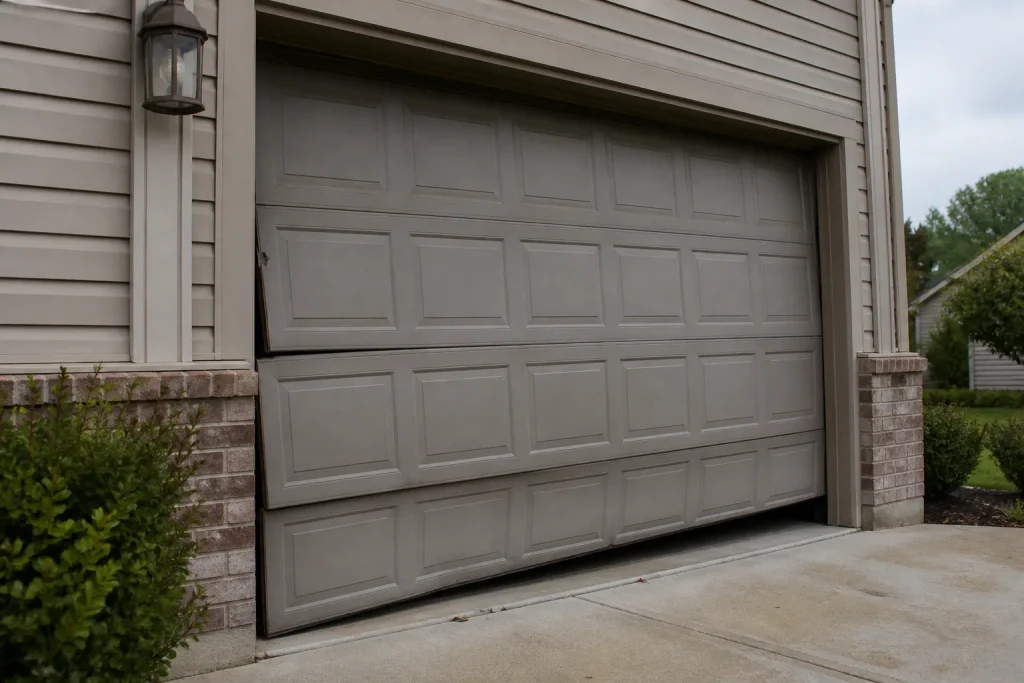
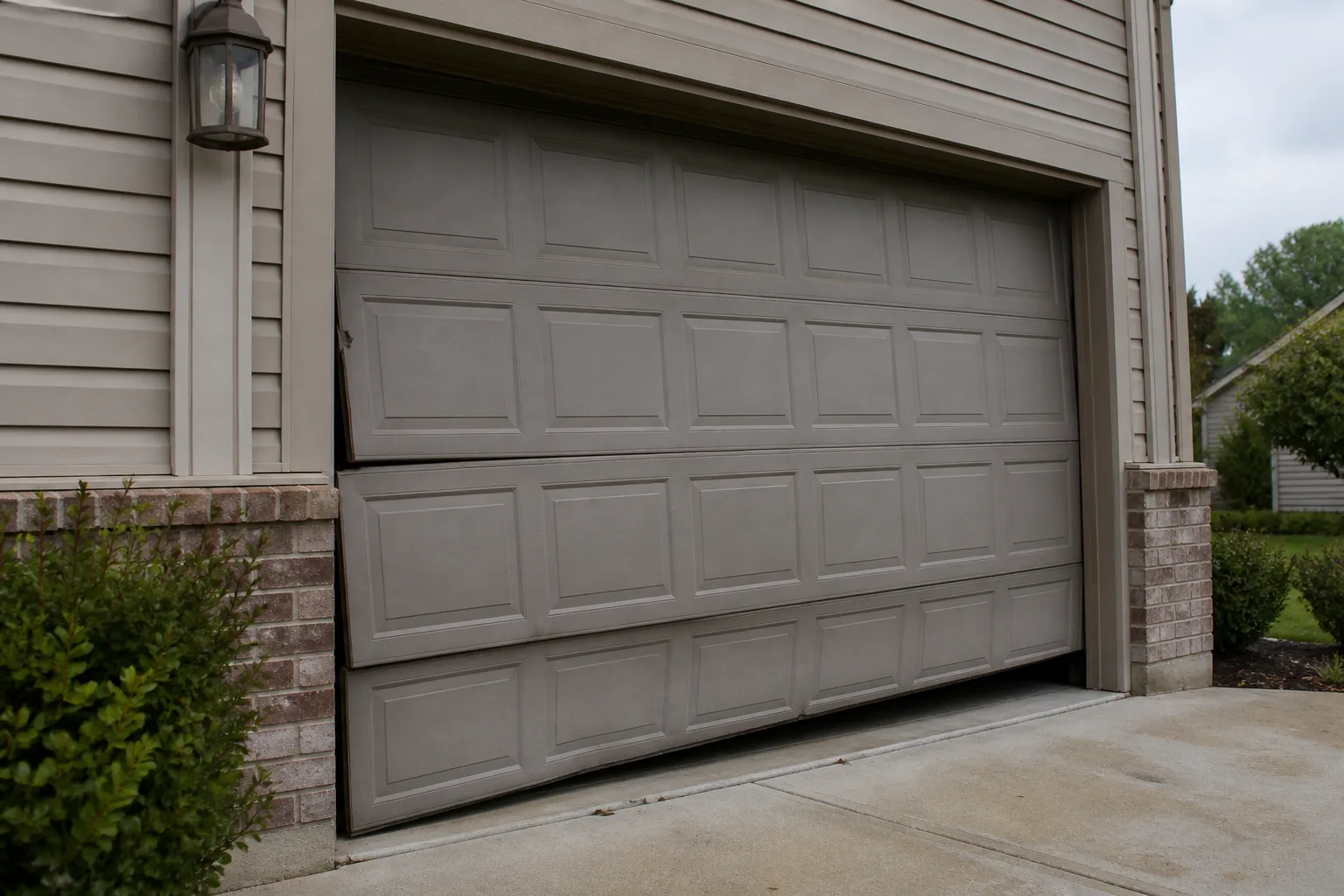
The distinction is everything, and it’s the one most homeowners get wrong. A panel that’s visually bowed but still moves freely and holds its shape is usually cosmetic surface wear. A panel that sags in the middle while the door is under load is structural, and it changes how urgently you need service. Here’s how to tell the difference:
- Cosmetic: a dent or slight bow from impact, with the door still opening and closing evenly. Worth watching, not an emergency.
- Structural: the middle of the door dips while it’s lifting, the gap along the top or bottom edge is uneven, or one side lags behind the other.
- Structural and urgent: the panel sags and the door shudders, binds or comes off the track when operated.
Sagging under load in a Hilliard door usually points to a cracked or fatigued panel, or an underlying balance problem where one spring is doing more work than the other. A steel Clopay or Amarr door that sags mid-span often has a bent strut or a hinge pulling loose, and that flex stresses the opener every single cycle. If a panel is structurally compromised, it should not be pushed through another season. Replacement panels are matched by brand and model, and we work on doors from Clopay, Amarr, Wayne Dalton and Genie among the eight major brands we service.
Why does my door reverse before it hits the floor?
A door that goes back up on its own is not automatically a sensor problem, even though that’s the first thing most people blame. There are three root causes behind that behavior, and only one of them is the safety sensor. The other two signal an opener under strain or a spring about to fail:
- Misaligned or dirty safety sensors: the invisible beam gets blocked or knocked out of line. Common after a bump with a snow shovel. Easiest to fix.
- Excess force detection: the opener senses resistance on the way down and reverses for safety. That resistance is often a binding track, a dragging roller, or a door that’s out of balance.
- Spring failure in progress: the door is heavier than the opener can safely lower, so force detection reverses it every time. This is the one to take seriously.
Here’s a quick way to sort them out. Disconnect the opener and lower the door by hand. If it drops smoothly to the floor, the sensors are the likely cause. If it fights you or feels heavy, the springs or balance are involved and the door should be treated as a spring issue. A door that reverses intermittently also points to something temperature-sensitive, which brings us to Hilliard’s cold months. Don’t keep cycling a heavy door to “test” it; each reversal puts wear on the opener’s gears.
What cold-weather warning signs matter in Hilliard?
Central Ohio winters put a specific kind of strain on garage doors, and Hilliard homes see it every year. Some seasonal complaints are normal. Others are the door telling you something is about to fail. Watch for these three:
- A bottom seal that lets in cold air or drafts: a stiff, cracked or frost-frozen seal lets water and cold in and lets heat out. It also stresses the door’s bottom edge. If you can see daylight under the closed door, the seal needs replacing.
- Thickened lubricant triggering false overload signals: cold turns light grease into paste, drags the door, and the opener interprets that drag as an obstacle and reverses or stops. It often reads like a broken opener when it’s really a maintenance issue.
- Metal contraction throwing off balance: cold steel shrinks enough to change tension. A door that was fine in October can feel noticeably heavier in January.
If your door reverses specifically on cold mornings but works in the afternoon, that pattern points to drag and contraction rather than a dead opener. Greasing the rollers and hinges with the right cold-rated lubricant often helps, but if the door still strains, the springs deserve a proper look. Winter failure matters more than in summer because a stuck-open door leaves a home unsecured. We answer 24/7. Fast dispatch from 7am to 7pm, Sunday through Friday, so a cold-morning failure gets booked fast.
What should a 2-minute cable and spring inspection look like?
A visual check of your cables and springs takes two minutes, and it can prevent a door-off-track emergency. The trick is knowing what to look for. Look only. Never touch a spring or cable under tension. Here’s what the problems look like in plain terms:
- Rust: orange or brown dust around the spring coils, or a rusty streak on the cable. Rust on a torsion spring is a wear indicator, not just a cosmetic issue.
- Fraying: a cable should look like clean, tightly twisted steel. Broken strands poking out like a frayed rope end mean the cable is failing and the door is at risk of going off track.
- Coil gaps: run your eye along a torsion spring. If you see a gap between coils, the spring has stretched or the winding is off. Run your eye, not your hand.
- Extension spring gaps: a visible space between the spring’s coils, or a stretched section, warns of fatigue.
Check both springs, not just one. A matched pair is typically replaced together, because a spring that’s done most of the work for years will fail soon after its partner. Look at the cables on both sides, and glance at the track for dents or gaps. If you spot fraying, a coil gap or anything that looks like a bent track, call us at (833) 918-9857 before operating the door again. The garage door repair professionals we connect you with work on all major brands, so there’s no guesswork about whether your system is recognized.
When should I call a pro instead of waiting?
Some signs you can watch. Others you shouldn’t. Call for help when any of the following is true: a spring has broken or the door feels heavy enough to strain it, a cable is frayed, the door has come off its track or won’t close, a panel is structurally compromised, or the door reverses on its own every time it lowers. These are the situations where continuing to run the door causes more damage or risks injury. Spring work and cable work are the two most dangerous repairs a homeowner can attempt, so leave them to trained hands.
For anything short of those, watch and note patterns. Our technicians have up to 11 years of experience across the major brands, from LiftMaster and Chamberlain openers to Genie systems and the full range of doors. If you’re not sure whether what you’re seeing is serious, a free estimate settles it without guesswork.
Related services in Hilliard
When a warning sign turns into a real repair, we cover the whole range: garage door repair for panels, tracks and off-track doors, opener diagnostics, and spring service. If you’d like to understand the full scope of what a specialist handles, visit Hilliard Garage Door Repair Pros.
The Bottom Line
Nearly every garage door failure announces itself first: a new noise, a slower cycle, a sagging panel, a door that reverses, a draft under the seal, a gap in the coils. The speed and balance test and the 2-minute cable and spring look are the two checks that catch most of these problems early. The one rule worth remembering: watch the springs and cables, but never touch them. If you’re in Hilliard and need help, Hilliard Garage Door Repair Pros offers free estimates. Call (833) 918-9857 and we’ll tell you what’s going on. We answer 24/7. Fast dispatch from 7am to 7pm, Sunday through Friday, and the price is agreed before any work starts.
Frequently Asked Questions
Most repairs are quoted per job based on what’s actually wrong, and the written estimate sets the final price before any work starts. Minor adjustments and sensor fixes sit at the low end, while spring replacement, cable work and panel repairs cost more because they need proper parts and training. Call (833) 918-9857 for an exact quote. Estimates are free.
Same-day service is available for repair and emergency calls, and we prioritize doors that are stuck open or a vehicle that’s trapped. We answer 24/7, with fast dispatch from 7am to 7pm, Sunday through Friday. Call (833) 918-9857 and we’ll book you in. A call outside dispatch hours is booked into the next opening.
No. The price is quoted and agreed before any work starts, so the written estimate you approve is the number you’ll see. If we find a second problem while we’re in, we tell you and quote it separately before touching it. Call (833) 918-9857 for a free estimate.
Yes. The local professionals we connect you with are licensed and insured as their state requires. They work on all eight major garage door and opener brands, including Genie, Clopay, Amarr and Wayne Dalton, so your system gets recognized rather than guessed at. Call (833) 918-9857 to get started. Estimates are free.
Written by the team at Hilliard Garage Door Repair Pros.
Need Garage Door Help?
Call Hilliard Garage Door Repair Pros - the local pro we connect you with is licensed and insured, here with fast help in Hilliard.
(833) 918-9857